Problem Overview
Gun Violence is a problem that has increased in the United States since the beginning of the 21st Century. The reasons vary between on how easy states make it to acquire a weapon, and depending on your age you are more likely to die from a gun either by your own hand or somebody else’s. This is a big problem and we have to find a solution, this has to stop so Americans can live their lives without the fear of a gun in their minds.
Different causes of deaths
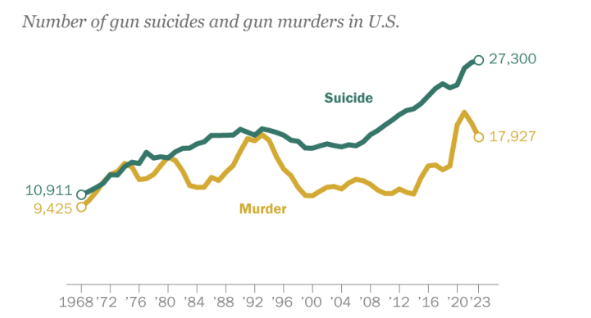
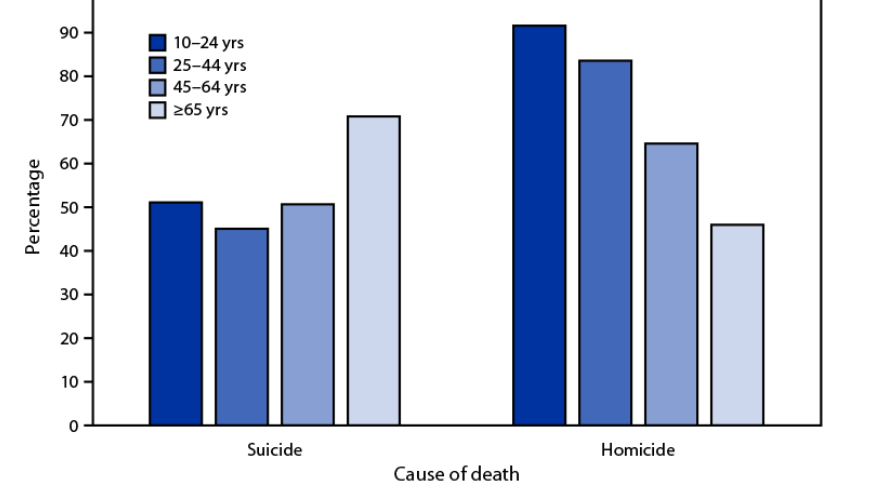
- HomicideMeanwhile in the other side of the coin, 42.9% of deathsby guns in the US is by homicide, young people in the agerange between 15-25 years old are the most probable to dieby homicide, and they make up to 91.3% of homicide deathsin the united states. Sad reality we live in, a 15 year old ismore probable to die by a gun than an adult. Suicide:In 2023 there were reported more than 45,000 deaths by firearms,24,900 of those deaths were by suicide, which adds up to 53.7%of all deaths by guns. 70.8% of gun suicides are in the age group of older individuals between 45-70 years of age. Because more than 90% of suicide in the United States are by guns it is safe to say if we fix the problem of weapons, we can simultaneously solve the suicide problem in the US.
Source: pewresearch.org
Age range and cause of death
Source: cdc.gov
Why should we care?
This is one of the biggest issues in the United States, not only deaths by homicide, but this is also tied to depression causing suicide, there is a lot of issues related to this gun violence and where it generates. There’s bullying, which can cause people with unstable mental health to start having either suicidal or violent thoughts. There’s domestic violence, and how it can affect couples and children with the risk of a gun. There is alcoholism and how people with
drinking problems have easy access to guns and how they can use it recklessly. We could go on forever with all the problems tied to gun violence but I am going to stop here because I think you get my point. Gun Violence is a problem and we need to solve it ASAP.
State level policies and how effective they were
State policies in the state of California
Gun Violence Restraining Orders (GVROs)
- In California, a GVRO is a civil court order that temporarily prohibits an individual who is determined to pose a significant risk of harming themselves or others from owning, possessing, purchasing, or receiving firearms, ammunition, or magazines.
- The law in California was first enacted in 2014 (signed into law in 2014; took effect January 1, 2016) as the state’s version of what is often called a “red flag” law (or extreme risk protection order).
- Purpose: to provide a mechanism to intervene before a crime or self-harm occurs by removing access to guns when someone is deemed high risk.
Source: americanhealth.jhu.edu
Uniform Carry Concealed Weapons Licenses
- The relevant law says that a person “who desires to carry a concealed weapon in public” must obtain a Carry Concealed Weapon (CCW) license from the sheriff of the county or the chief of police of a city.
California does not recognize concealed carry permits issued by other states.
Effectiveness of these policies
source: usafacts.org
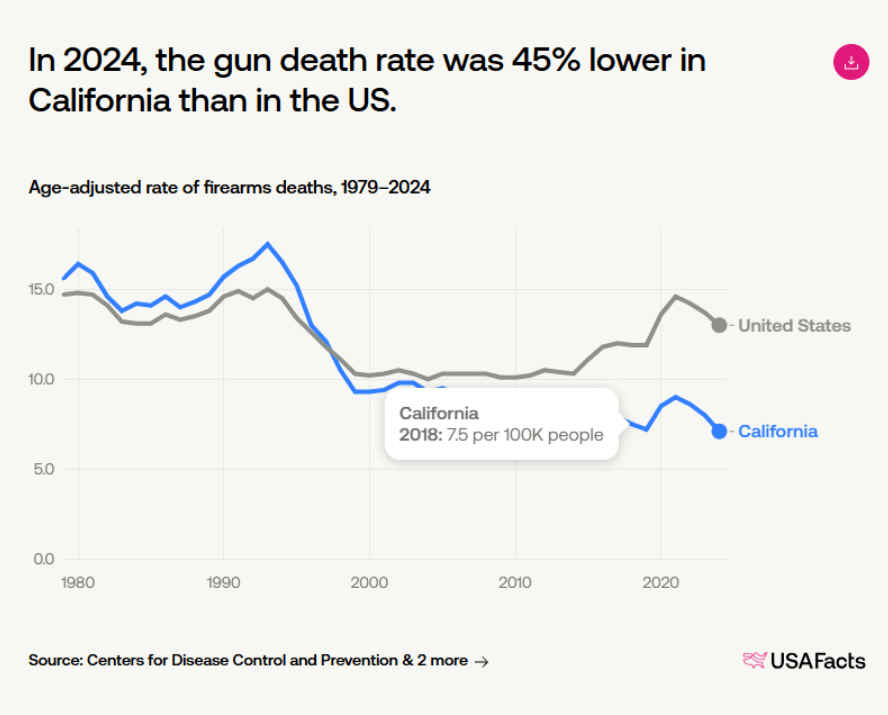
According to the data after the implementation of the GVROs in 2016 the rate of deaths by guns in California decreased so it shows that it was effective.
In 2024 after the “Uniform Carry Concealed Weapons Licenses” bill was passed the death rate by firearms decreased to the lowest it has ever been since the 1970s.
How is this better than what the US is doing?
Due to the fact that the US is giving each states the freedom to do whatever they want with this issue and allowing them to create the laws each state decides on. What this does is that some states have little to no regulations on guns while other states create stricter laws to prevent this issue.
What are states doing better?
Because states depend only on themselves to work on this issue they have more free space to make regulating laws, in the other hand the US needs approval of the majority of congress to pass a national law and congress is represented by the different states and their representative’s interests.
United States Legislature
Why is the Legislative branch important?
Congress is essential for creating national gun-violence prevention laws.
To pass legislation, a majority in both the Senate and House of Representatives must agree.
Gaining support in Congress is necessary to implement broad firearm regulations.
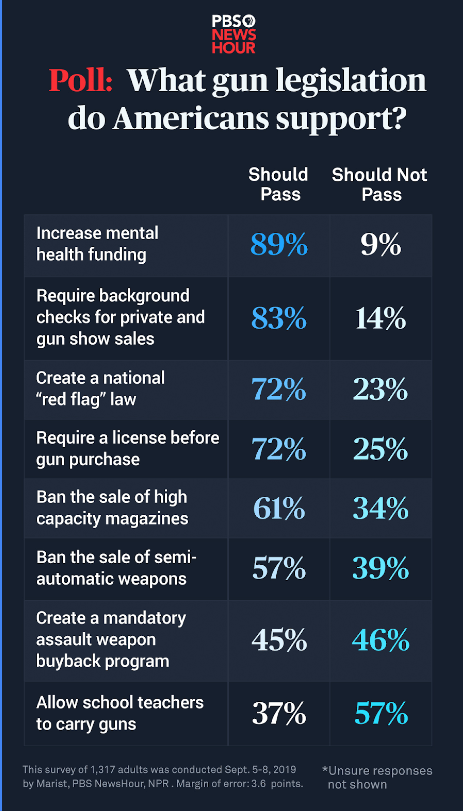
Support by public to make stricter gun laws
The graph and PBS source show strong public support for stricter gun laws.
Widespread support among Americans helps build momentum for legislative action.
Source: pbs.org
How the U.S. Legislature Works Internally
Congress consists of the House of Representatives and the Senate.
Both chambers must pass a bill in identical form before it becomes law.
Committees examine and revise bills before chamber-wide votes.
This system ensures multiple perspectives but slows action on controversial issues like gun control.
How Congress Affects Efforts to Address Gun Violence
Congress shapes nationwide gun policies because federal law overrides state laws.
Only Congress can create national rules such as universal background checks, waiting periods, and red flag laws (RAND Corporation).
Political polarization often prevents progress on widely supported measures.
OpenStax explains that Congress’s system balances public power with deliberation, which slows urgent policymaking. This structure makes passing gun-reform legislation especially challenging.
Example from OpenStax
OpenStax explains that the House represents the population, while the Senate represents states. This structure complicates gun reform because measures supported by the House may fail in the Senate. Equal state representation in the Senate gives smaller rural states disproportionate influence. Demonstrates how Congress’s design both enables and limits gun-policy progress (OpenStax).
Sources and works cited
Source 1 (OpenStax)
OpenStax describes how Congress functions: bicameral structure, committees, and checks and balances.
These features explain why passing federal gun laws is difficult.
Supports claim by showing Congress is central to any national gun-policy strategy.
Reinforces the thesis that understanding internal structure is key to achieving reform.
Source 2 (Pew Research Center)
Pew data shows strong public support for stricter gun policies, including from gun owners.
Provides hard evidence that national gun-safety measures have broad approval.
Supports the thesis by demonstrating that persuading Congress is feasible due to voter backing.
Source 3 (RAND Corporation)
RAND provides scientific evidence that gun-safety policies like background checks and waiting periods reduce firearm deaths.
Supports argument for promoting evidence-based national legislation.
Reinforces the thesis that Congressional action is needed to implement effective policy nationwide.
https://www.rand.org/research/gun-policy/analysis.html
Why the United States Government doesn’t deal with this issue?
As explained before congress is a very important if not the most important part of the US branches of government to pass a bill as important as a national regulation bill to guns.
You need to pass the bill through two chambers before the whole branch votes on it, and if it passes again then it goes to the president and he needs to approve it where it can finally become law.
Usually bills related to gun control get rejected on the chambers or are put on hold where it takes time to come back to it.
If states legislators don’t receive enough pressure from the public then they tend not to pass through the chambers, that is why public support and pressure is very important to get congress on passing a bill.
Federalism
How Federalism Works Internally
Federalism is the system that divides power between the national government and the states. According to OpenStax American Government 3e, states retain broad authority over public safety and criminal law, including most gun regulations, unless Congress sets national standards. This creates a system where states can pass their own gun laws, resulting in large differences across the country.
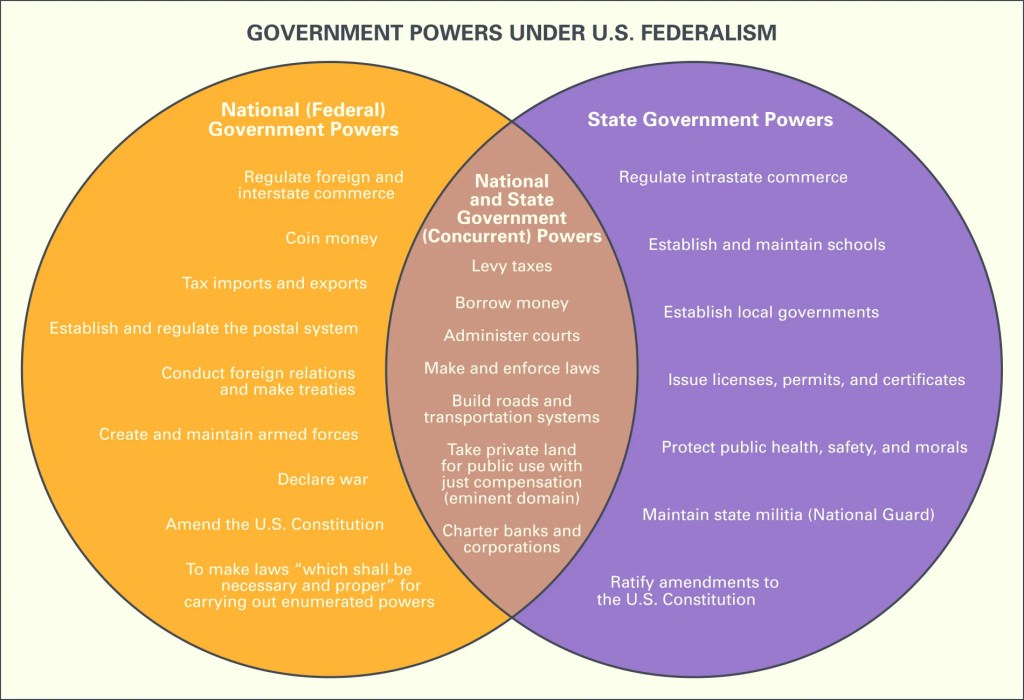
Source:https://www.britannica.com/topic/federalism
How Federalism Helps or Gets in the Way
Federalism helps by allowing states to act as “laboratories of democracy.” States like California and New York have passed strong gun safety laws that show reductions in gun deaths. However, federalism also gets in the way because guns easily cross state borders. States with weak gun laws undermine stricter states, making national progress difficult.
Why the Problem Isn’t Solved Nationally
States’ rights arguments and political resistance prevent Congress from setting strong nationwide standards. Even when public support exists, federalism allows states to block or weaken national efforts.
Why This Matters Strategically
Understanding federalism helps readers see why state action alone is not enough and why national coordination is necessary.
Sources:
- OpenStax. American Government 3ehttps://openstax.org/details/books/american-government-3e
- RAND Corporation – State Variation in Gun Lawshttps://www.rand.org/research/gun-policy.html
The Supreme Court

How the Supreme Court Works Internally
The Supreme Court interprets the Constitution and determines whether laws violate constitutional rights. Through judicial review, the Court has the final say on whether gun laws passed by Congress or states are constitutional (OpenStax).
How the Court Helps or Gets in the Way
The Court helps by clarifying constitutional limits, but it often restricts gun regulation. In District of Columbia v. Heller (2008), the Court ruled that individuals have a right to own firearms. More recently, New York State Rifle & Pistol Association v. Bruen (2022) limited states’ ability to regulate concealed carry.
Why the Problem Isn’t Solved Nationally
Because the Court can strike down laws, Congress is hesitant to pass strong gun regulations that may be ruled unconstitutional. This creates a legal ceiling on reform.
Why This Matters Strategically
This shows that even if Congress acts, lasting reform must survive judicial review, making legal strategy just as important as legislation.
Sources:
- OpenStax. American Government 3ehttps://openstax.org/details/books/american-government-3e
- Supreme Court of the United States – DC v. Hellerhttps://www.supremecourt.gov/opinions/07pdf/07-290.pdf
- Brennan Center – Bruen Decision Explainedhttps://www.brennancenter.org/our-work/analysis-opinion/supreme-courts-bruen-decision-explained
US National Strategy: Implementing Gun Violence Prevention Policy in the United States
Defining the National Strategy
Based on the analysis of state-level success, congressional authority, federalism, and judicial limits, the most realistic national strategy for reducing gun violence is a federal baseline approach. This strategy focuses on passing limited but effective national standards such as universal background checks, waiting periods, and red-flag laws while still allowing states to enact stronger protections if they choose. This approach balances federal authority with state flexibility, making it both politically and legally feasible.
Why Congress Is Central to the Strategy
As discussed in Blog #3, Congress is the only institution capable of creating nationwide gun policy. Federal laws override state laws, meaning Congress must act to prevent weaker state laws from undermining stronger ones. Public opinion data shows broad national support for gun safety measures, which can be used to pressure lawmakers to propose and vote on legislation.
- OpenStax explains that Congress’s committee system and bicameral structure slow the process, but do not prevent action if bipartisan support exists.https://openstax.org/details/books/american-government-3e
How Federalism Shapes the Strategy
Federalism explains why gun violence policy has been uneven across states. While states like California have demonstrated that stricter laws reduce gun deaths, states with weak laws allow firearms to flow across borders. A national baseline policy would address this issue while preserving states’ rights to go further if desired.
This strategy builds on what already works at the state level instead of replacing it, aligning with the “laboratories of democracy” concept discussed in OpenStax.
Accounting for Supreme Court Limits
Supreme Court rulings such as District of Columbia v. Heller and New York State Rifle & Pistol Association v. Bruen limit how far gun regulations can go. Because of this, the national strategy must focus on policies that regulate access and safety, not outright bans. Laws like background checks and red-flag orders have been shown to be effective while remaining constitutionally defensible.
Why This Strategy Is Realistic
Research summarized by RAND shows that evidence-based policies like background checks and waiting periods reduce firearm deaths, supporting their national adoption.https://www.rand.org/research/gun-policy/analysis.html
Additionally, Pew Research data shows that a majority of Americans—including gun owners—support these measures, making them politically viable.https://www.pewresearch.org/short-reads/2024/07/24/key-facts-about-americans-and-guns/
Conclusion
The most effective national strategy to address gun violence is one that combines state-level success, congressional authority, federal coordination, and constitutional awareness. While no single institution can solve the problem alone, coordinated federal action that respects legal limits and builds on proven state policies offers the strongest path forward. Understanding these political options and limitations allows citizens and policymakers to focus their efforts where change is most achievable.
 Gun Violence Prevention
Leave a comment